Rereading Haroun allowed me to open my eyes more and dig deeper into the true purpose. I could see the underlying, more mature themes that surfaced once I gained a better understanding of the novel throughout my second reading. At first, I read the novel like a children’s story by reading it in my head as if I were reciting it to children. However, as I read it again, I couldn’t help but notice that it seemed as if Rushdie wrote this story with no target audience. There were complex ideas and themes all within the silly names and plot of that of a children’s book.
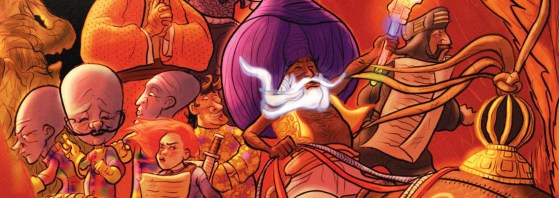
“Happy endings must come at the end of something. If they happen in the middle of a story, or an adventure, or the like, all they do is cheer things up for a while.” (Rushdie 202).
For starters, Haroun’s mother left his father for their neighbor because she didn’t understand the point in storytelling, which caused his father to lose his power to tell stories. Haroun then embarks on an adventure to get his father’s power back, and at the end when all conflict is solved and his mother returns, you could say that it is a classic ending. The Walrus says this near this time, and I just couldn’t help but reread it a couple times because it makes a lot of sense and helps me further understand Rushdie’s intention for the ending. Through this quote, I think Rushdie added this to say that happy endings aren’t real because stories continue on and that just because everything is fine now doesn’t mean it will be later.
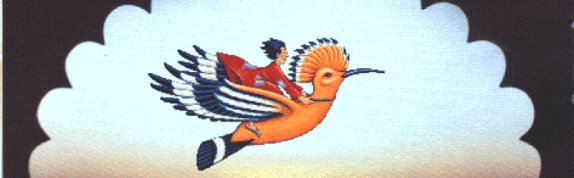
Throughout our two Socratic Seminar discussions, the intriguing idea I couldn’t stop thinking about was the point brought up about the irony of the ending and how Rushdie could’ve purposely portrayed the misconception of “Hollywood” endings. The ending was very “fairytale” as someone described it because all conflict was resolved and Haroun’s mother returned and they became a happy family again. Because of Rushdie’s comments on the nonexistence of happy endings, I believe he was attempting to show how abrupt and odd they are since it seemed weird how everything just went back to normal so quickly. This can be seen in movies as well, where conflicts are resolved very unrealistically and seem forced, which I believe he is trying to show by ending the story this way.
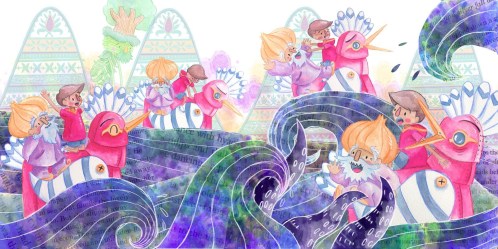
As part of the allusion lens group in the second reading, I searched for ways he could’ve incorporated real ideas and things into a fictional story. The idea of reading Haroun and the Sea of Stories with respect to a certain idea was interesting to me. Specifically, the allusion lens was intriguing because when I reread the novel a second time, I spotted them more easily and realized that a clear understanding of the concepts in the book in order to see the connections that Salman Rushdie was attempting to make through incorporating the allusions. You could see that the references he was making contributed greatly to the story as a whole and exposed his writing style to a new level.

At first, I believed the novel was only for children, and I didn’t understand why we were reading it as high school students. However, the story posed a very interesting question that made me think: “What’s the use of stories that aren’t even true?”. I began to think of a reason that would completely justify our odd love for what some would call “morally good lies”, and it really opened up a new door for me. Why do we find false pieces of writing? Is it because we want to imagine it as our own world? I am still pondering this question after reading, but I do believe that this novel helped me understand and really learn the power of stories and storytelling. From Jonathan Gottschall’s “Storytelling is an Animal”, I couldn’t help but notice something he said that was along the lines of spending more time in “Neverland” than in reality, which shows that stories are our life and that we live in stories. You may think that they are just made-up words and fantasies, but if you really dig deep you will learn just how important to your life they are.

In the midst of my First Reading-First Thoughts blog post, I included that I was confused about the sudden ending and who exactly Salman Rushdie intended this novel to be for. As I kept reading, I picked up on some more mature themes and references that children wouldn’t exactly understand. There was a clear conflict as well, so I thought it was developing greatly. In the end, after reading it twice, it surprised me because of the first impression I got, that it was just going to be a silly children’s story that you could imagine reading out loud to a child. But I quickly realized the more powerful meaning behind the book and that it wasn’t just a silly novel but rather something that counteracted on stories themselves. Haroun and the Sea of Stories led me to ponder some complex questions that I have never thought of, and as a result, I am pleased that I had the opportunity to read it.
LINKS:
http://movies2.nytimes.com/books/99/04/18/specials/rushdie-haroun.html
https://journals.lib.unb.ca/index.php/IFR/article/view/705/1035
https://www.publishersweekly.com/978-0-670-83804-2

 Journey of the Mind